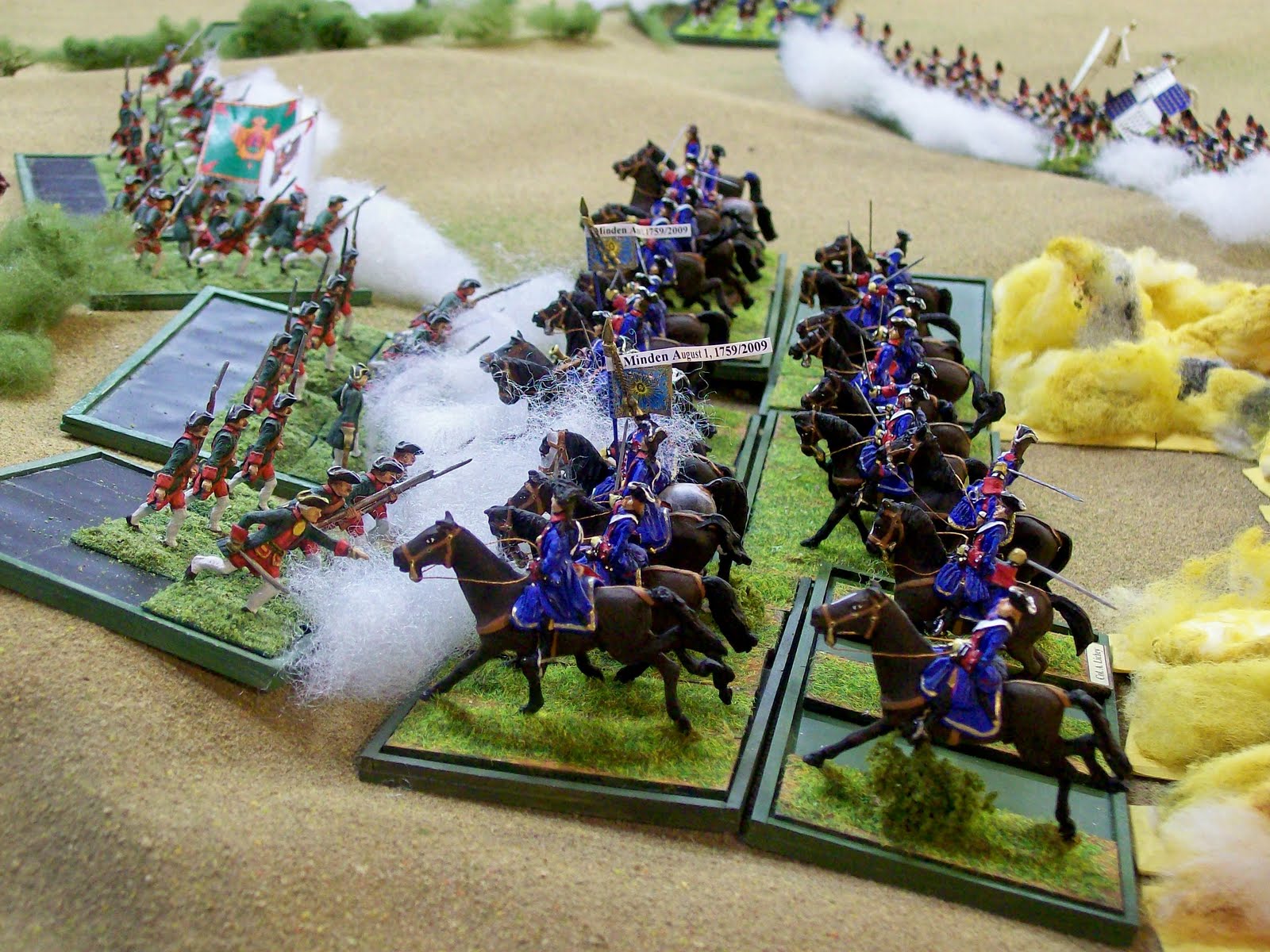
Eureka designed a range of attractive War of Austrian Succession Dutch cavalry two years ago. Mine though have been uniformed as Seven Years' War French Gendarmes. Click images to fill your screens with....
Left: Gendarmes Anglais; Miniature Figurines recovered and increased from an older disused collection.
Center: Eureka Gendarmes de la Reine. Right: Eureka Gendarmes Dauphin.
Foreground: Gendarmes Dauphin. Miniatures are individually based and magnetized to underlying trays. No casualty records are kept this way. Remove and set aside.
Monsieur l'Brigadier, Prussian cavalry appears in the distance. There Monsieur!
Bring the brigade into line then, en muiralle, if you please, mon ami.
----------
Closing Remarks:
1. The Eurekas are elegant, anatomically correct and -- take a look at the lovely horses.
2. Three squadrons of fifteen each plus three more to command the brigade. Total: 48.
3. Mini Figs were placed on thicker stands to bring their smaller size closer to the larger Eurekas.
4. The two large standards are from GMB.
5. Comments welcome -- below.
----------
Thursday, July 15, 2010
Friday, June 25, 2010
Chapter 3 of 3: Schlacht Bei Tannesberg Ended
Date: 22 June 1760/2010
Location: A Tannes Mountain Pass/Defile
Where Exactly? North Of Frankfurt Am Main
Situation: Rebel Force Found And Engaged
Also See: June 9 and 23 entries for prior history
Sirs, if you please, click on photos 1-2 times to enlarge them
----------
Our last entry left us hanging with a just commenced cavalry versus infantry mélée. And now we see the result of swordplay. The rebels pay for their sedition, lose heavily, check morale.....
and hold! The horsemen elect to rally back (off screen right). They could have remained to mélée again next turn but Lt. Colonel l'Comte de Lichey pulled back - perhaps because a rebel regiment of heavy horse began to appear not far away (off screen left).
Indeed, that regiment of horse did come forward and then withdrew to cover the withdrawal of the rebel force. See them in the upper middle in white coats. Der Hurtshog Artur is seen riding bravely forward in front of 1/Grenadiers de France. His Brigade de Guerre moves forward consolidating.
Artur may be seen on the left. His Garde Grenadier are on the right moving through light woods. To their left is 2/Grenadiers de France. In the foreground are l'Comte de Lichey and, -- I can't say.
Artur moves forward joining the commander of 1/Grenadiers de France to watch enemy horsemen ride away seemingly on a collision course with the blue coats atop the rise.
The enemy cavalry commander salutes his opponents with his tricornered hat.
Meanwhile the blue coat battalion opened an interval to allow the horsemen to pass through them. Two of the battalions central divisions previously about faced, marched to the rear, faced and marched outwards halting behind battalion flank divisions. All proper drill per the era. Well-done!
It's time to close the interval. The previously withdrawn divisions retrace their steps and....
Reform an ordered three rank line ready to meet Artur's advance. However....
Der Hurtshog has other ideas!
Artur: "Advance the guns!" They will deploy in the space just ahead while....
On the right the battalion gun assigned to the Garde Grenadiers also moves forward.
On the far left flank, 1/Grenadiers de France await orders from Artur. A moment later....
Artur sagt,: "FEUER!
Rebel jagers appear unconcerned. Nearby....
Two red coated senior officers look on. Are they Britannian advisers, paymasters, commanders or?
They are difficult to see. It matters little for the Aide de Camp clearly heard Artur say, "They did not pass!"
----------
Closing Remarks
1. This was a fun game. Hopefully it worked into Arthur's campaign. Certainly l'Comte de Bastille, the Gallian Intendant back in Frankfurt Am Main will be delighted. Super delighted if it were possible.
2. It also is the smallest BAR game, we've played, roughly 200 miniatures per side. No problem.
3. Losses were 2:1 in favor of Artur; roughly 92 for the rebels and about half that for Artur.
4. The game ended shortly after the infantry versus cavalry mélée. Photos after this were staged by yours truly to end the story and to show how it was possible to withdraw cavalry through an infantry line.
5. Thank you Arthur. Get well soon!
6. Thank you Chuck and John - the Tuesday night game crew. Well done!
7. Comments welcome next as usual -- below.
----------
Wednesday, June 23, 2010
Chapter 2 of 3: Der Hurtshog En Bataille
Date: 22 June 1760/2010
Location: A Tannes Mountain Pass/Defile
Where Exactly? North Of Frankfurt Am Main
Situation: Rebel Force Found And Engaged
Also See: June 9 entry for prior history leading to this action
Sirs, if you please, click on photos 1-2 times to enlarge them
Also See: June 9 entry for prior history leading to this action
Sirs, if you please, click on photos 1-2 times to enlarge them
----------
Courier: "I beg to report Your Excellency, the Rebel Force is observed and upon its march not one hour behind me. Descending the pass Sire."
Der Hurtshog Artur von Frankzonia: "Good. Goooood. My compliments to you Lt. Gen. Armentieres and if you please, clear for action!"
Armentieres doffing his tricornerd hat: "We shall make it so, Your Highness."
The Rebel Commander, John, descends the pass entering a narrowing of the defile.
Artur: Well, that's what I used to say when serving with the Rhine River Flotilla years ago. Old habits.
Armentieres: Oui. Your brigade is deploying now.
Chuck as Armentieres moves forward toward the rebels. The Gallian Régiment Royale leads the way and...
appear to desire to charge as the first motion. Good? Perhaps. Exciting? YES! The near rebel battalion is disordered by terrain. It's the right moment....
But no! A clever ruse de l'guerre to stall the rebel march. Moments before a left about by fives was ordered and the regiment retired.
First shots from 2/Grenadiers de France assisting Artur's battle-group. The opponents are rebel jagers. In the distance the Hurtshog's Garde Grenadier advance and will soon engage more jagers.
While more rebel forces march toward the sound of battle. The defile troubles their order.
As the firefight becomes general near to far, the Royals return to charge at the gallop and....
----------
Closing Remarks
1. A small fast game.
2. Three battalions and a regiment of breastplated horse per side.
3. Game Start: 7:25pm.
4. Game Conclusion: 8:45pm. The last photo is about 40 minutes into the game.
5. Rules: Batailles de l'Ancien Régime 1740-1763 known as BAR.
6. Return soon for the conclusion.
7. Comments welcome below. Let's talk.
----------
Wednesday, June 9, 2010
Chapter 1 of 3: Gallia Assists Frankzonia
Date: 09 June 1760 (2010)
Location: Outskirts Of Frankfurt Am Main
Situation: Hurtshog Of Frankzonia Takes Command In The Field
Mission: Stop An Emboldened Seditious Frankzonian Rebel Force
Images Expand Amazingly When Clicked 1-2 Times
----------
Der Hurtshog Artur von Frankzonia ist zu pferde. He precedes his guard battalion outside Frankfurt Am Main. Other units follow.
Artur, centered, is handsomely attired in a Marshall's uniform; a gift from Gallian l'Comte de Bastille l'Intendant de Frankfurt Am Main.
The Guard climbs the hill.
Two more battalions and two squadrons come into view. These are Gallian allies: Grenadiers de France and the Royal Cavalry Regiment. There appear to be three small cannon as well.
The Royal's second squadron on the left.
The Royal's first squadron observed by the regimental commander, l'Comte André Lichey on the far right. More clearly seen now are two battalions of Grenadiers de France and the Hurtshog's Guard.
Behind the scenes a Gallian officer watches the departure of the brigade. Who is he?
l'Comte de Bastille
A few hours later the Brigade marches within a forest south of Frankfurt Am Main.
The drapeau of 2/Grenadiers de France of Gallia.
Der Hurtshog Artur von Frankzonia on the white horse confers with a Gallian Lt. General.
----------
Closing Remarks
1. Arthur asked for volunteers to do three "proxy" battles for him.
2. The force you've seen is upon its march for one of these to put down Frankzonian seditious elements believed to be en-route through passes and defiles to the south.
3. Return for more as time goes by for this brigade action.
4. Manufacturers: Stadden Prussian Guard, Foundry French Hurtshog and Officer on horse near him, Garrison Grenadiers de France On Guard, Front Rank Grenadiers de France marching and David Wilson's "Willie" French Horse. The Inn is from Miniature Building Authority. (Out of production)
5. BAR rules will be used; Batailles de l'Ancien Régime 1740-1763. See: oldregimerules.com
6. The game will be undertaken in a couple of short sessions on weeknights after work.
----------
Tuesday, May 11, 2010
Guess Who?
For Fun Guess: Unit Identity, Manufacturer and Product
Click images to make them larger, if you please. Try double clicking.
My newest unit. Top paper strength was 158. At 1:10 that's 15 or 16 miniatures. I'm adding more. There will eventually be three ranks of five miniatures each. If you want to guess, do so below clicking on the word "comments." Merci.
-----------------------
Monday, April 26, 2010
FRENCH SEVEN YEARS’ WAR HEAVY CAVALRY BREASTPLATES
Misconception or Reality?
Courtesy of Seven Years’ War Association Journal Volume XIV #4 - Winter 2008/2009
Bill Protz
There has been thinking that French heavy cavalry did not wear breastplates at times or at all during the SYW. In my case, this goes back through decades of dimly recalled memories reminding me of three things. First, officers refused to wear them out of a sense of misplaced bravery/honor. Second, the piece was thrown away because it was too heavy or uncomfortable. Third, many uniform illustrations don’t show them. Are these misconceptions or realities?
---
Lieutenant General Sir Reginald Savory, His Britannic Majesty’s Army In Germany During The Seven Years War
At the battle of Hastenbeck, “The gallant Chevert led his [infantry] men forward, wearing his ‘cordon-rouge’ and without his cuirasse. When pressed to don his cuirasse, he replied, pointing to his men, ‘Have these brave fellows got any?’ Page 32.
---
Lee Kennett, The French Armies In The Seven Years’ War. Duke University Press, 1971.
“…the Count of Gisors, received a mortal would leading a charge at Krefeldt; had he been wearing the cuirasse, it would probably have saved his life.” Page 70.
“Cavalry officers were to wear the complete breastplate [front and back], though as has been seen, the custom was more honored in the breach than in the observation.” Page 117. Kennett is perhaps referring to the death of the Count of Gisors here. The regulation comes from the Ordonnance du Roi concernant l’armement des officers et des sergeans des companies de fusiliers du 31 octobre 1758.
“The practice may have been dictated as much by comfort as vanity. The physician Colombier said the cuirasse or breastplate was too heavy and troubled the respiration and constricted the shoulders and neck.” Page 117. From Code I, page 131.
”Regulations stipulated that cavalrymen …were to wear as defensive armor a half-breastplate or plastron, and an iron skull cap inside their hats.” Page 117. From Sautai and Desbrère’s on pp. 13-15 of Cavalerie.
---
Liliane and Fred Funcken, The Lace Wars Part 2. Ward Lock Limited, 1977.
“The breastplate alone was in theory worn by all cavalry regiments, but there was little enthusiasm for it, and it was often left off, contrary to regulations.” Page 22.
René Chartrand, Louis XV’s Army (I) Cavalry & Dragoons. Osprey Publishing, 1996.
“All troopers were also equipped with a steel breast-plate painted black, but this bulky item was unpopular and not often worn, even in wartime.” Page 13.
---
Lucien Mouillard, THE FRENCH ARMY OF LOUIS XV. G.F. Nafziger translated the 1882 work in 2004.
“The armament and equipment of the cavalry trooper was excellent in the time of Louis XIV, but did not change after that, and consisted of: The iron breastplate, fastened at the back with leather straps, that crossed on the back. Only the Cuirassier Regiment wore a double breastplate [front and back]. The officers carried … a double cuirass.” Pages 71-72.
Writing about the Gendarmes, “The plastron of the cuirass was of bronzed iron, lined with linen padding, trimmed with crimson silk, fixed at the shoulders with red leather suspenders with buckles and hooks of bronzed iron,” Page 101.
Mouillard’s original artwork depicting French heavy cavalry from 1737-1762 all wear the breastplate with the exception of the Cuirassiers du Roi wearing the front and back cuirass. The breastplate is not depicted on the Gendarmes or Guard cavalry perhaps to show details of the outer coat.
---
Lucien Rousselot Reference Sources cited in Part 10 of R. D. Pengel’s and G. R. Hurt’s FRENCH CAVALRY & DRAGOONS 1740-1762. 1981.
“When wearing [the buff vest for practice exercises but not in action] the officers wore cuirasses and the other ranks black plastrons. The plastron was often worn by officers and other ranks under the coat in action. The cuirass was bordered in red lace with yellow metal fittings. Unlike the Prussian style it had a back protection also.” This citation appears to the left of the plate RG1 about half way through this booklet. Several sketches appear of the breastplate.
---
Christopher Duffy, PRUSSIA’S GLORY. The Emperor’s Press, 2003.
In the aftermath of the Prussian victory at Rossbach Duffy remarks, “It took several days to clear the wreckage from the battlefield and the neighborhood…’The roads were littered with French cuirasses, great riding boots which had been thrown away…. and with lost hats. The sunken road by Markwerben was full of hacked-about Frenchmen.” Page 85.
---
Christian Rogge on the SYW yahoo egroup on October 17, 2007 wrote:
Having done a bit of closer research on 7YW French vs. Allies campaigns, I would forward (my personal) conclusion based on the below:
A) We/I know of accounts of French cav. wearing breastplates at [1757] Rossbach and 1758
Lutterberg. The first because of the recorded abandoned cuirasses during the rout (see
Duffy), the latter because existing records of Hanoverian infantry at Lutterberg deliberately aiming at the horses on the French cav. charges for the French were in armour. The charges of the 6 esc. Dauphin brigade identified here – not that of the Cuirassiers [du Roi] !!! (see French language, but Hanoverian origin relation publ. in Westphalen). To my knowledge, no such records exist for Minden or Krefeld, to name the two other most famous engagements. That doesn't say NO armour was worn on these occasions.
B) The wearing of cuirasses was 7YW regulation - especially in battle!
C) It wasn't popular - so, (I say) - avoided with the marches - i.e. usual everyday service.
Armour [was] conventionally kept with the regimental baggage - somewhere behind during
the march periods.
D) Idea of no armour for French cav. is based mainly on uniform illustrations of French cavalry without cuirasse/plastron. Most are based on 18th c. contemporary material most often illustrating uniforms without cuirasses, because you would not see much of the uniform distinctions with the cuirasse.
Conclusion: French did wear armour in deliberately planned or expected engagements, but
might have not done so at unexpected combats, such as Korbach or Warburg, or of the more operational then pitched encounters like Gruenberg or Nauheim, which really happened to make up for most of the engagements during this war in this part of the world.
---
Ingo Beringer on the Lace Wars yahoo egroup on July 26, 2006 wrote:
At the battle of Crefeld Hessian light troops on foot were interspersed in the first line of the attacking Allied wing. When the heavy cavalry of the French were attacking, the Hessians were ordered to aim at the horses instead of the riders as the cuirassiers wore breastplates, which would have made them invulnerable. The Hessians did as they were told, with cruel effect. Source: the report of a sergeant named George Bess who took part in the fight
More information from Ingo in an email: (George Beß). „Aus dem Tagebuch eines Veteranen des Siebenjährigen Krieges. Mitgetheilt durch den Obersten z.D. Wilhelm Beß." Zeitschrift des Vereins für hessische Geschichte und Landeskunde, N.F., Band 2, S. 193–241. - (My) translation: From the Diary of a Veteran of the Seven Years' War. Communicated by Colonel (in active service) Wilhelm Bess. Journal of the Society for Hessian History and Geography, new series, vol. 2, pp 193 to 241. (The name of George Bess is not given in the title of the paper). - It is a most interesting paper excerpting from the original papers of George Bess who was a subject of the Landgraf of Hessen-Kassel. He lived from 1734 to 1810. He was a hunter by occupation. Shortly after the start of his career he was (more or less forcefully) recruited for a Jäger company. I suppose you know that Jäger is the word for the civil trade of a hunter as well as the military troop type. George had such a positive record in his activities that he was promoted to Corporal in the first year of his service, then Sergeant in the following year, and Sergeant Major in the year after. He took part in three battles and was wounded five times. After the war he was granted a senior employment in the Landgraf's forestry service, in recognition of his merits. Colonel Wilhelm Bess was the author's grandson. (As a quite irrelevant note: GEORGE was at that time pronounced Schorsch (or English: shorsh), not Georg (English: gay-org) as today).
---
Ingo Beringer on the SYW yahoo egroup on October 18, 2007 wrote:
As for Minden I clearly remember having read about French breastplates in the context of battlefield findings in one of the commemorative books of the 1959 anniversary though I forgot the exact place.
----------
----------
CONCLUDING COMMENTS AND PROBLEMS:
1. Regulations ordered heavy cavalry troopers to wear frontal armor breastplates called plastrons.
2. The same regulations ordered officers to wear front and back armor.
3. Wearing armor was unpopular for some due to weight, breathing issues and encumbrance.
4. Some officers flouted the regulation due to vanity.
5. Every heavy regiment was issued with armor.
6. Armor was thrown away in the rout following the defeat at Rossbach. To get away easier?
7. Is the Rossbach anecdote the genesis of the idée-fixe that the French threw away their armor?
8. A lot of artwork does not show armor so uniforms are not obscured.
9. Thus miniatures designers have not crafted SYW French heavy cavalry in plastrons. Nor do we find officers with front and back armor except for the Cuirassier du Roi Regiment. This total absence is unjustifiable. My familiarity is with 25mm-30mms only.
10. Those unaccustomed to research, lacking resources, trusting rules writers as their sole source of information and also trusting manufacturers may think there was no armor worn.
11. There is a philosophy afoot these days that if a wargame miniature does not have something on the casting, it cannot have it in a wargame. In view of Items #s 8 and 9, this is wrong.
12. There is a difference between disliking armor and wearing it anyway, especially in battle.
13. What percentage of troopers and officers did not wear their armor?
14. What percentage wore armor?
15. Per Table 3 of Kennett, The Army of the Lower Rhine on 17 June 1758 shows:
83 squadrons of heavy horse presumably wearing breastplates. (70.9% of all cavalry)
10 squadrons of hussars without armor. (8.5% of all cavalry)
24 squadrons of dragoons without armor. (20.5% of all cavalry)
117 squadrons total
16. Are the percentages of Item #15 viable? Yes and no. Hussars and dragoons were normally not present on main battlefields. They were usually on the flanks but more usually miles away guarding lines of communications, scouting, screening, protecting supplies, blocking, foraging, marauding and so forth. Thus in a large main battle, the percentage of breastplated horse would be much higher than 70.9%. However, at smaller affairs the story would be very different. The heavies might be a small minority if not absent altogether.
SYNTHESIS
{a} The French Cuirassiers du Roi Regiment wore front and back armor on top of their coats.
{b} Other French heavy regiments were supposed to wear breastplates (plastrons) under outer coats but on top of waistcoats. They did this unless in a surprise engagement.
{c} Officers at the regimental level and above were supposed to wear front and back armor. Some did not.
(d) Ask wargame miniatures manufacturers to provide French heavy cavalry wearing plastrons under the outer coat and officers wearing front and back armor if they do not now do so.
Misconception or Reality?
Courtesy of Seven Years’ War Association Journal Volume XIV #4 - Winter 2008/2009
Bill Protz
There has been thinking that French heavy cavalry did not wear breastplates at times or at all during the SYW. In my case, this goes back through decades of dimly recalled memories reminding me of three things. First, officers refused to wear them out of a sense of misplaced bravery/honor. Second, the piece was thrown away because it was too heavy or uncomfortable. Third, many uniform illustrations don’t show them. Are these misconceptions or realities?
---
Lieutenant General Sir Reginald Savory, His Britannic Majesty’s Army In Germany During The Seven Years War
At the battle of Hastenbeck, “The gallant Chevert led his [infantry] men forward, wearing his ‘cordon-rouge’ and without his cuirasse. When pressed to don his cuirasse, he replied, pointing to his men, ‘Have these brave fellows got any?’ Page 32.
---
Lee Kennett, The French Armies In The Seven Years’ War. Duke University Press, 1971.
“…the Count of Gisors, received a mortal would leading a charge at Krefeldt; had he been wearing the cuirasse, it would probably have saved his life.” Page 70.
“Cavalry officers were to wear the complete breastplate [front and back], though as has been seen, the custom was more honored in the breach than in the observation.” Page 117. Kennett is perhaps referring to the death of the Count of Gisors here. The regulation comes from the Ordonnance du Roi concernant l’armement des officers et des sergeans des companies de fusiliers du 31 octobre 1758.
“The practice may have been dictated as much by comfort as vanity. The physician Colombier said the cuirasse or breastplate was too heavy and troubled the respiration and constricted the shoulders and neck.” Page 117. From Code I, page 131.
”Regulations stipulated that cavalrymen …were to wear as defensive armor a half-breastplate or plastron, and an iron skull cap inside their hats.” Page 117. From Sautai and Desbrère’s on pp. 13-15 of Cavalerie.
---
Liliane and Fred Funcken, The Lace Wars Part 2. Ward Lock Limited, 1977.
“The breastplate alone was in theory worn by all cavalry regiments, but there was little enthusiasm for it, and it was often left off, contrary to regulations.” Page 22.
René Chartrand, Louis XV’s Army (I) Cavalry & Dragoons. Osprey Publishing, 1996.
“All troopers were also equipped with a steel breast-plate painted black, but this bulky item was unpopular and not often worn, even in wartime.” Page 13.
---
Lucien Mouillard, THE FRENCH ARMY OF LOUIS XV. G.F. Nafziger translated the 1882 work in 2004.
“The armament and equipment of the cavalry trooper was excellent in the time of Louis XIV, but did not change after that, and consisted of: The iron breastplate, fastened at the back with leather straps, that crossed on the back. Only the Cuirassier Regiment wore a double breastplate [front and back]. The officers carried … a double cuirass.” Pages 71-72.
Writing about the Gendarmes, “The plastron of the cuirass was of bronzed iron, lined with linen padding, trimmed with crimson silk, fixed at the shoulders with red leather suspenders with buckles and hooks of bronzed iron,” Page 101.
Mouillard’s original artwork depicting French heavy cavalry from 1737-1762 all wear the breastplate with the exception of the Cuirassiers du Roi wearing the front and back cuirass. The breastplate is not depicted on the Gendarmes or Guard cavalry perhaps to show details of the outer coat.
---
Lucien Rousselot Reference Sources cited in Part 10 of R. D. Pengel’s and G. R. Hurt’s FRENCH CAVALRY & DRAGOONS 1740-1762. 1981.
“When wearing [the buff vest for practice exercises but not in action] the officers wore cuirasses and the other ranks black plastrons. The plastron was often worn by officers and other ranks under the coat in action. The cuirass was bordered in red lace with yellow metal fittings. Unlike the Prussian style it had a back protection also.” This citation appears to the left of the plate RG1 about half way through this booklet. Several sketches appear of the breastplate.
---
Christopher Duffy, PRUSSIA’S GLORY. The Emperor’s Press, 2003.
In the aftermath of the Prussian victory at Rossbach Duffy remarks, “It took several days to clear the wreckage from the battlefield and the neighborhood…’The roads were littered with French cuirasses, great riding boots which had been thrown away…. and with lost hats. The sunken road by Markwerben was full of hacked-about Frenchmen.” Page 85.
---
Christian Rogge on the SYW yahoo egroup on October 17, 2007 wrote:
Having done a bit of closer research on 7YW French vs. Allies campaigns, I would forward (my personal) conclusion based on the below:
A) We/I know of accounts of French cav. wearing breastplates at [1757] Rossbach and 1758
Lutterberg. The first because of the recorded abandoned cuirasses during the rout (see
Duffy), the latter because existing records of Hanoverian infantry at Lutterberg deliberately aiming at the horses on the French cav. charges for the French were in armour. The charges of the 6 esc. Dauphin brigade identified here – not that of the Cuirassiers [du Roi] !!! (see French language, but Hanoverian origin relation publ. in Westphalen). To my knowledge, no such records exist for Minden or Krefeld, to name the two other most famous engagements. That doesn't say NO armour was worn on these occasions.
B) The wearing of cuirasses was 7YW regulation - especially in battle!
C) It wasn't popular - so, (I say) - avoided with the marches - i.e. usual everyday service.
Armour [was] conventionally kept with the regimental baggage - somewhere behind during
the march periods.
D) Idea of no armour for French cav. is based mainly on uniform illustrations of French cavalry without cuirasse/plastron. Most are based on 18th c. contemporary material most often illustrating uniforms without cuirasses, because you would not see much of the uniform distinctions with the cuirasse.
Conclusion: French did wear armour in deliberately planned or expected engagements, but
might have not done so at unexpected combats, such as Korbach or Warburg, or of the more operational then pitched encounters like Gruenberg or Nauheim, which really happened to make up for most of the engagements during this war in this part of the world.
---
Ingo Beringer on the Lace Wars yahoo egroup on July 26, 2006 wrote:
At the battle of Crefeld Hessian light troops on foot were interspersed in the first line of the attacking Allied wing. When the heavy cavalry of the French were attacking, the Hessians were ordered to aim at the horses instead of the riders as the cuirassiers wore breastplates, which would have made them invulnerable. The Hessians did as they were told, with cruel effect. Source: the report of a sergeant named George Bess who took part in the fight
More information from Ingo in an email: (George Beß). „Aus dem Tagebuch eines Veteranen des Siebenjährigen Krieges. Mitgetheilt durch den Obersten z.D. Wilhelm Beß." Zeitschrift des Vereins für hessische Geschichte und Landeskunde, N.F., Band 2, S. 193–241. - (My) translation: From the Diary of a Veteran of the Seven Years' War. Communicated by Colonel (in active service) Wilhelm Bess. Journal of the Society for Hessian History and Geography, new series, vol. 2, pp 193 to 241. (The name of George Bess is not given in the title of the paper). - It is a most interesting paper excerpting from the original papers of George Bess who was a subject of the Landgraf of Hessen-Kassel. He lived from 1734 to 1810. He was a hunter by occupation. Shortly after the start of his career he was (more or less forcefully) recruited for a Jäger company. I suppose you know that Jäger is the word for the civil trade of a hunter as well as the military troop type. George had such a positive record in his activities that he was promoted to Corporal in the first year of his service, then Sergeant in the following year, and Sergeant Major in the year after. He took part in three battles and was wounded five times. After the war he was granted a senior employment in the Landgraf's forestry service, in recognition of his merits. Colonel Wilhelm Bess was the author's grandson. (As a quite irrelevant note: GEORGE was at that time pronounced Schorsch (or English: shorsh), not Georg (English: gay-org) as today).
---
Ingo Beringer on the SYW yahoo egroup on October 18, 2007 wrote:
As for Minden I clearly remember having read about French breastplates in the context of battlefield findings in one of the commemorative books of the 1959 anniversary though I forgot the exact place.
----------
----------
CONCLUDING COMMENTS AND PROBLEMS:
1. Regulations ordered heavy cavalry troopers to wear frontal armor breastplates called plastrons.
2. The same regulations ordered officers to wear front and back armor.
3. Wearing armor was unpopular for some due to weight, breathing issues and encumbrance.
4. Some officers flouted the regulation due to vanity.
5. Every heavy regiment was issued with armor.
6. Armor was thrown away in the rout following the defeat at Rossbach. To get away easier?
7. Is the Rossbach anecdote the genesis of the idée-fixe that the French threw away their armor?
8. A lot of artwork does not show armor so uniforms are not obscured.
9. Thus miniatures designers have not crafted SYW French heavy cavalry in plastrons. Nor do we find officers with front and back armor except for the Cuirassier du Roi Regiment. This total absence is unjustifiable. My familiarity is with 25mm-30mms only.
10. Those unaccustomed to research, lacking resources, trusting rules writers as their sole source of information and also trusting manufacturers may think there was no armor worn.
11. There is a philosophy afoot these days that if a wargame miniature does not have something on the casting, it cannot have it in a wargame. In view of Items #s 8 and 9, this is wrong.
12. There is a difference between disliking armor and wearing it anyway, especially in battle.
13. What percentage of troopers and officers did not wear their armor?
14. What percentage wore armor?
15. Per Table 3 of Kennett, The Army of the Lower Rhine on 17 June 1758 shows:
83 squadrons of heavy horse presumably wearing breastplates. (70.9% of all cavalry)
10 squadrons of hussars without armor. (8.5% of all cavalry)
24 squadrons of dragoons without armor. (20.5% of all cavalry)
117 squadrons total
16. Are the percentages of Item #15 viable? Yes and no. Hussars and dragoons were normally not present on main battlefields. They were usually on the flanks but more usually miles away guarding lines of communications, scouting, screening, protecting supplies, blocking, foraging, marauding and so forth. Thus in a large main battle, the percentage of breastplated horse would be much higher than 70.9%. However, at smaller affairs the story would be very different. The heavies might be a small minority if not absent altogether.
SYNTHESIS
{a} The French Cuirassiers du Roi Regiment wore front and back armor on top of their coats.
{b} Other French heavy regiments were supposed to wear breastplates (plastrons) under outer coats but on top of waistcoats. They did this unless in a surprise engagement.
{c} Officers at the regimental level and above were supposed to wear front and back armor. Some did not.
(d) Ask wargame miniatures manufacturers to provide French heavy cavalry wearing plastrons under the outer coat and officers wearing front and back armor if they do not now do so.
Monday, March 29, 2010
Mollwitz Right Flank at SYWA Assn. 27th Weekend
Situation: 27th Seven Years' War Assn. Annual Weekend
Date: March 26-27, 2010
Location: South Bend, Indiana USA, Ramada Inn Downtown
Topic: Right Flank of Jim/Der Alte Fritz's Leuthen Game
----------
Why the right flank? That's where yours truly was posted commanding his Saxon Rutowski Chevauleger Regiment under wing commander Brent Olson. I also judged this sector of the game. Jim (Der Alte Fritz) took more photos of the entire battle for his blog which will hopefully appear in due course. Consider this just a brief movie trailer, if you please until these appear. Kindly click on images to make them fill your screens. And now....
Date: March 26-27, 2010
Location: South Bend, Indiana USA, Ramada Inn Downtown
Topic: Right Flank of Jim/Der Alte Fritz's Leuthen Game
----------
Why the right flank? That's where yours truly was posted commanding his Saxon Rutowski Chevauleger Regiment under wing commander Brent Olson. I also judged this sector of the game. Jim (Der Alte Fritz) took more photos of the entire battle for his blog which will hopefully appear in due course. Consider this just a brief movie trailer, if you please until these appear. Kindly click on images to make them fill your screens. And now....
The snowy right flank at Leuthen. Austrian kürassiers approach Prussian dragoons.
That's Tom Miller patiently awaiting the Austrian onslaught.
The foes collide! Can your hear/imagine the collision?
Both sides won and lost several rounds of combat with the Prussians gaining advantages and pushing back the Austrians until the Rutowski Chevaulegers and more küassiers reinforce and in turn force the Prussians back. (Not shown.)
The Austrian and Saxon cavalry was forced to withdraw off screen to the left, onto a back table and afterwards through the wall of the room by these Prussian Infantry Battalions. There was no way to hold ground against these steady blue coats.
Here you see the town of Leuthen left of the Austrian and Saxon cavalry. In a few turns in spite of heroic defensive fire and the inability of the Prussian Garde to knock down the gate to Leuthen Church, yours truly ordered the withdrawal of all allied forces onto the back table. A clear Prussian victory. We don't get many draws using Batailles de l'Ancien Régime rules (BAR for short).
The next day I took one photo of our experienced game-master Der Alte Fritz on the left flank at Mollwitz. He presided over two excellent what if scenarios, (Leuthen and Mollwitz) featuring a lot of back and forth action, suspense, heroics, fun, laughter and gorgeous miniatures ensembled on captivating winter terrain from his collection. No glum faces in these two games and 5-6 people played in both games.
The scenario guru, Der Alte Fritz!
-------------------------------------------------------
Closing Remarks
1. I would appreciate all the players in the two BAR games making comments below. Let's talk to keep the fun and memories going!
2. Others too.
----------
Subscribe to:
Posts (Atom)